
Table of Contents
- n8n: The Workflow Automation Powerhouse
- Activepieces: The MIT-Licensed Zapier Alternative
- Node-RED: The IoT and Edge Computing Veteran
- Huginn: The Self-Hosted Agent Pioneer Showing Its Age
- Temporal: Enterprise-Grade Durable Workflow Orchestration
- FlowiseAI: The Visual AI Agent Builder
- Comprehensive Comparison Across All Six Platforms
- Docker Deployment Across All Platforms
- Ranked Recommendation: From Most to Least Broadly Useful
- Deploy Any of These Tools in 30 Seconds with Dublyo
- What Makes Dublyo Different From Other Hosting Options
- Quick Deployment Reference
- Conclusion
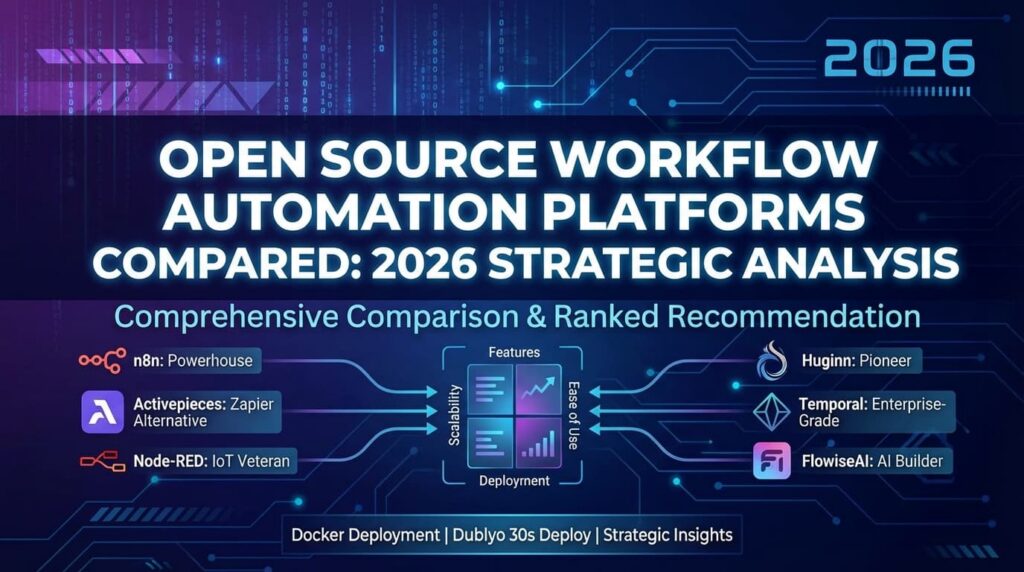
n8n dominates the space with 174k GitHub stars, native AI capabilities, and the strongest balance of visual simplicity and code flexibility, but each platform serves a distinct niche. The six tools reviewed here range from general-purpose automation (n8n, Activepieces) to IoT-focused flow programming (Node-RED), developer-grade orchestration (Temporal), legacy agent systems (Huginn), and AI-specific builders (FlowiseAI). Your ideal choice depends on whether you need no-code business automation, code-first distributed systems, IoT edge computing, or AI agent development. Below is a thorough breakdown of each platform with current 2025-2026 data, followed by comparison tables and ranked recommendations.
n8n: The Workflow Automation Powerhouse
n8n (pronounced “nodemation”) is a fair-code workflow automation platform founded in 2019 by Jan Oberhauser in Berlin. It combines a visual node-based editor with full JavaScript/Python code support, making it uniquely flexible. The platform has raised $240M in total funding at a $2.5B valuation and serves 200,000+ active users. Its explosive growth – from 75k to 174k GitHub stars in under a year – was driven largely by its native AI/LLM capabilities.
| Attribute | Details |
|---|---|
| GitHub Stars / Forks | ~174,000 / ~54,700 |
| Language / Stack | TypeScript, Node.js, Vue.js, PostgreSQL, Redis |
| Integrations | 400-500+ native nodes (1,200+ with community nodes), ~70 AI-dedicated nodes |
| License | Sustainable Use License (fair-code) |
| Docker Image | docker.n8n.io/n8nio/n8n – 100M+ Docker pulls, port 5678 |
| Self-Hosting | Easy via Docker; production needs PostgreSQL + Redis. Min 1 CPU / 2 GB RAM |
| Community | 73k+ Discord, 45k+ forum members, weekly releases |
| Pricing | Community (free self-hosted, unlimited), Starter €20/mo, Pro €50/mo, Enterprise custom |
Pros:
- Unmatched flexibility combining visual no-code with full JS/Python code nodes and npm packages
- Native LangChain integration with ~70 AI nodes, agent builders, RAG support, and MCP protocol – the strongest AI-native automation platform
- Self-hosted Community Edition is completely free with unlimited workflows and executions
- Execution-based pricing (not per-step) makes complex multi-step workflows dramatically cheaper than Zapier or Make
- Massive, active community with 174k stars, abundant templates (~5,000), and rapid development cadence
Cons:
- Steep learning curve for non-technical users; initial setup can be complex
- Key enterprise features (SSO, Git version control, environments) locked behind paid Business/Enterprise tiers
- Self-hosting requires DevOps expertise for production – database management, SSL, backups, monitoring
- Fewer native integrations than Zapier (6,000+) or Make (1,500+), though HTTP Request nodes bridge most gaps
Best for: Technical teams, AI/ML developers building LLM agents, privacy-conscious organizations needing self-hosted automation, and companies outgrowing Zapier/Make.
Activepieces: The MIT-Licensed Zapier Alternative
Activepieces is an open-source, AI-first automation platform founded in 2022 by ex-Google engineer Mohammad and 3x founder Ashraf in San Francisco. Backed by Y Combinator (S22), it positions itself as a truly open-source Zapier alternative under the MIT License – a key differentiator from n8n’s fair-code model. It claims 100,000+ users from organizations including Google, Roblox, and ClickUp.
| Attribute | Details |
|---|---|
| GitHub Stars / Forks | ~20,800 / ~3,300 |
| Language / Stack | TypeScript (100%), React, Fastify, PostgreSQL, Redis |
| Integrations | 636+ pieces, ~400 MCP servers, 60% community-contributed |
| License | MIT (Community Edition) |
| Docker Image | activepieces/activepieces – supports amd64 + arm64 |
| Self-Hosting | Easy single-container Docker run with PGLite; production needs PostgreSQL + Redis |
| Community | ~5,400 Discord, 270+ contributors, frequent releases |
| Pricing | Community (free self-hosted), Cloud Standard $5/active flow/mo, Unlimited custom |
Pros:
- Genuine MIT open-source license – no fair-code restrictions, full freedom to modify and redistribute
- Excellent, intuitive UI consistently praised on Product Hunt (4.8/5) and AppSumo (4.9/5) – most approachable for non-technical users
- AI Agents 2.0 with autonomous sense-plan-act capabilities, ~400 MCP servers, and built-in AI copilot
- Self-hosted Community Edition provides unlimited task executions at zero cost
- Strong developer extensibility with TypeScript SDK for custom pieces and hot-reloading
Cons:
- Smaller integration library (636 vs. n8n’s 1,200+) with some pieces described as “half-baked”
- Younger platform (2022) with fewer battle-tested production deployments and performance gaps under high throughput
- Pricing model instability – multiple changes frustrated early adopters and AppSumo lifetime deal holders
- Limited enterprise track record with only ~19 employees and reliance on community support channels
Best for: SMBs seeking a cost-effective Zapier replacement, non-technical teams needing intuitive no-code automation, and organizations wanting genuine open-source licensing.
Node-RED: The IoT and Edge Computing Veteran
Node-RED is an open-source, flow-based programming tool created at IBM in January 2013 by Nick O’Leary and Dave Conway-Jones. Now governed by the OpenJS Foundation under the Apache 2.0 license, it’s the most mature platform in this comparison. Its sweet spot is IoT, industrial automation, and edge computing – it runs on everything from Raspberry Pi Zero to enterprise servers.
| Attribute | Details |
|---|---|
| GitHub Stars / Forks | ~22,800 / ~3,800 |
| Language / Stack | JavaScript, Node.js, Express.js |
| Integrations | 5,837 community node packages + 3,057 shared flows |
| License | Apache 2.0 (fully open source) |
| Docker Image | nodered/node-red – official multi-arch (amd64, arm32, arm64, s390x) |
| Self-Hosting | Very easy – runs on 256 MB RAM, Raspberry Pi, single npm install |
| Community | 40,000+ forum topics, annual Node-RED Con, Hitachi as major contributor |
| Pricing | 100% free. Commercial FlowFuse platform from $20/mo adds enterprise features |
Pros:
- Massive integration ecosystem with 5,837+ community nodes covering virtually every protocol (MQTT, OPC-UA, Modbus, Serial) and service
- Extremely lightweight – runs on devices with 256 MB RAM, including Raspberry Pi Zero, making it ideal for edge computing
- 13 years of maturity with production deployments at Fortune 500 manufacturers, healthcare systems, and smart buildings
- Fully open source under Apache 2.0 with no vendor lock-in; flows are portable JSON files
- Rapid prototyping – users build solutions in hours that would take days with traditional coding
Cons:
- Scalability challenges – monolithic JSON flow files make version control and multi-developer collaboration painful
- Limited built-in enterprise features (no HA, RBAC, audit logs without FlowFuse); single-user by default
- JavaScript lock-in with no native support for Python, Go, or Java workflows
- No built-in AI features – AI capabilities come only through community nodes and manual HTTP integrations
Best for: IoT developers, industrial engineers (IIoT/SCADA), home automation enthusiasts, rapid prototypers, and edge computing deployments where lightweight resource usage matters.
Huginn: The Self-Hosted Agent Pioneer Showing Its Age
Huginn is a self-hosted automation system for building agents that perform automated tasks, created by Andrew Cantino in 2013. Named after Odin’s raven representing “thought,” it pioneered the concept of autonomous software agents years before the AI era. The New York Times used it during the 2014 Winter Olympics. Despite 48.3k GitHub stars, the project is now effectively in maintenance mode.
| Attribute | Details |
|---|---|
| GitHub Stars / Forks | ~48,300 / ~4,200 |
| Language / Stack | Ruby on Rails, MySQL/PostgreSQL, DelayedJob |
| Integrations | ~50+ built-in agent types plus external Ruby gems |
| License | MIT |
| Docker Image | huginn/huginn – also on GHCR |
| Self-Hosting | Moderate-to-hard; requires 2-4 GB RAM (Rails is memory-hungry) |
| Community | Only 6 active contributors last quarter; last release Aug 2022; 603 open issues |
| Pricing | 100% free, no commercial version |
Pros:
- Completely free with zero usage limits – no per-task billing, feature gating, or execution caps
- Full data sovereignty with all processing on your server; ideal for privacy-sensitive use cases
- Powerful built-in web scraping via WebsiteAgent with CSS/XPath/JSONPath – stronger than most competitors’ free tiers
- Complex multi-step logic (branching, filtering, deduplication, digest aggregation) as core free features
- Proven stability – users report reliable operation for months with zero intervention once configured
Cons:
- Effectively unmaintained: last official release was August 2022, only 6 active contributors, 603 open issues and 91 unprocessed PRs
- No visual drag-and-drop editor – all configuration through JSON forms with a dated 2013-era UI
- Resource-hungry Ruby on Rails framework demands 2-4 GB RAM for moderate workloads
- No AI/ML capabilities and no modern integration ecosystem; each new connection requires manual HTTP configuration
Best for: Privacy-conscious developers comfortable with JSON configuration who need powerful web scraping and monitoring automation on a zero budget. Not recommended for new projects given maintenance concerns.
Temporal: Enterprise-Grade Durable Workflow Orchestration
Temporal is an open-source durable execution platform forked from Uber’s Cadence project, founded by Maxim Fateev and Samar Abbas around 2020. Unlike the other tools here, Temporal is a code-first workflow orchestration engine – there’s no visual editor. Developers write workflows in Go, Java, Python, TypeScript, .NET, PHP, or Ruby with automatic state persistence and fault tolerance. It powers Stripe, Netflix, Snap, Coinbase, Twilio, and NVIDIA, processing 15 billion+ actions per day on Temporal Cloud.
| Attribute | Details |
|---|---|
| GitHub Stars / Forks | ~16,900 / ~1,200 |
| Language / Stack | Go (server), SDKs in 7 languages, PostgreSQL/MySQL/Cassandra |
| Integrations | 7 official SDKs + 4 community SDKs; ecosystem-based rather than connector-based |
| License | MIT |
| Docker Image | temporalio/auto-setup (dev), temporalio/server (prod) |
| Self-Hosting | Moderate-to-hard; min 7 components for full service; Kubernetes recommended for production |
| Community | Tens of thousands on Slack, 1,000+ Cloud customers, annual Replay conference |
| Pricing | Free self-hosted; Cloud from $100/mo (Essentials) to custom Enterprise |
Pros:
- Unmatched durability and reliability – workflows automatically persist state at every step and resume after crashes without custom recovery logic
- Workflow-as-code in 7 languages with native loops, conditionals, and try/catch – vastly superior DX versus YAML/JSON state machines
- Battle-tested at massive scale by Stripe, Netflix, Coinbase, and Twilio for mission-critical financial transactions
- Long-running workflow support (days, weeks, months) with durable timers that consume zero compute
- Growing AI/agent ecosystem with OpenAI Agents SDK integration and MCP support for durable LLM orchestration
Cons:
- Steep learning curve – determinism constraints on workflow code trip up most developers; effectively requires senior engineers
- Self-hosting is significantly complex with multiple services, database management, schema migrations, and shard configuration
- No visual editor or low-code interface – purely code-first, making it inaccessible to non-developers
- Vendor lock-in risk due to Temporal’s unique programming model; migrating away requires significant refactoring
Best for: Enterprise engineering teams building mission-critical distributed systems, microservices orchestration, financial transaction processing, and teams replacing fragile cron jobs or Celery tasks. Not suitable for no-code users or simple automation needs.
FlowiseAI: The Visual AI Agent Builder
FlowiseAI (Flowise) is an open-source, low-code platform for building AI agents and LLM workflows visually. Founded in 2023 by Henry Heng and Chung Yau Ong, backed by Y Combinator (S23), it was acquired by Workday in August 2025. Unlike general-purpose automation tools, Flowise is purpose-built for AI – wrapping LangChain into visual drag-and-drop components for RAG pipelines, chatbots, and multi-agent systems.
| Attribute | Details |
|---|---|
| GitHub Stars / Forks | ~49,100 / ~23,700 |
| Language / Stack | TypeScript, Node.js, React, LangChain, SQLite/PostgreSQL |
| Integrations | 100+ integrations (LLMs, vector DBs, document loaders, tools) |
| License | Apache 2.0 |
| Docker Image | Dockerfile in repo; elestio/flowiseai on Docker Hub |
| Self-Hosting | Moderate; npm install -g flowise or Docker. Needs Node.js v18+ |
| Community | ~12,400 Discord, 49k stars, active GitHub discussions |
| Pricing | Free self-hosted; Cloud: Free tier, Starter $35/mo, Pro $65/mo, Enterprise custom |
Pros:
- Excellent visual drag-and-drop interface for building AI agents, RAG systems, and chatbots – often described as “Figma for AI”
- Strong open-source foundation under Apache 2.0 with 49k+ GitHub stars and active development
- Supports both proprietary and open-source LLMs including OpenAI, Anthropic, Google Gemini, and local models via Ollama
- Rapid prototyping – users build functional RAG assistants in minutes with pre-built templates
- Enterprise backing from Workday acquisition ensures long-term stability and investment
Cons:
- Not a general workflow automation tool – limited to AI/LLM use cases; you’ll need separate tools for CRM, email, and business process automation
- Debugging complex multi-agent flows becomes messy at scale with the visual interface
- Enterprise features (RBAC, SSO, audit logging) locked behind paid Enterprise tier even for self-hosted deployments
- Workday acquisition may shift priorities toward enterprise HR/finance use cases, potentially deprioritizing community features
Best for: Developers building AI agents, RAG chatbots, and LLM-powered applications. Ideal for rapid AI prototyping and teams needing visual LLM workflow development with self-hosting capability.
Comprehensive Comparison Across All Six Platforms
| Category | n8n | Activepieces | Node-RED | Huginn | Temporal | FlowiseAI |
|---|---|---|---|---|---|---|
| GitHub Stars | 174,000 | 20,800 | 22,800 | 48,300 | 16,900 | 49,100 |
| GitHub Forks | 54,700 | 3,300 | 3,800 | 4,200 | 1,200 | 23,700 |
| Primary Language | TypeScript | TypeScript | JavaScript | Ruby | Go | TypeScript |
| License | Fair-code | MIT | Apache 2.0 | MIT | MIT | Apache 2.0 |
| Ease of Use | ★★★★☆ | ★★★★★ | ★★★★☆ | ★★☆☆☆ | ★★☆☆☆ | ★★★★☆ |
| Scalability | ★★★★☆ | ★★★☆☆ | ★★☆☆☆ | ★★☆☆☆ | ★★★★★ | ★★★☆☆ |
| Native Integrations | 400-500+ | 636+ | 5,837+ nodes | ~50 agents | 7 SDKs | 100+ |
| AI Capabilities | ★★★★★ | ★★★★☆ | ★★☆☆☆ | ★☆☆☆☆ | ★★★★☆ | ★★★★★ |
| Community Activity | ★★★★★ | ★★★☆☆ | ★★★★☆ | ★☆☆☆☆ | ★★★★☆ | ★★★★☆ |
| Docker Support | Official, 100M+ pulls | Official, multi-arch | Official, multi-arch | Official | Official docker-compose | Dockerfile in repo |
| Self-Host Difficulty | Easy-Moderate | Easy | Very Easy | Moderate-Hard | Hard | Moderate |
| Free Self-Hosted | ✅ Unlimited | ✅ Unlimited | ✅ Unlimited | ✅ Unlimited | ✅ Unlimited | ✅ Unlimited |
| Cloud Pricing Start | €20/mo | $5/flow/mo | $20/mo (FlowFuse) | None | $100/mo | $35/mo |
| Visual Editor | ✅ Node-based | ✅ Step-based | ✅ Flow-based | ❌ JSON forms | ❌ Code only | ✅ Drag-and-drop |
| Code Support | JS + Python | JS/TS | JavaScript | JS + Shell | Go/Java/Python/TS/.NET/PHP/Ruby | JS/Python SDK |
| Enterprise Features | SSO, RBAC, Git, Audit | SSO, RBAC, Audit, SOC 2 | Via FlowFuse | None | SSO, RBAC, multi-region | SSO, RBAC, Audit |
| Primary Use Case | General automation + AI | General automation | IoT + edge | Web scraping + monitoring | Distributed systems | AI agents + LLM apps |
| Maintenance Status | Very active | Very active | Active | ⚠ Maintenance mode | Very active | Active (Workday) |
| Founded | 2019 | 2022 | 2013 | 2013 | 2020 | 2023 |
Docker Deployment Across All Platforms
Every platform supports Docker, but the maturity and ease vary significantly.
| Platform | Docker Image | Quick Start Command | Production Notes |
|---|---|---|---|
| n8n | docker.n8n.io/n8nio/n8n |
docker run -p 5678:5678 -v n8n_data:/home/node/.n8n docker.n8n.io/n8nio/n8n |
Add PostgreSQL + Redis for queue mode scaling. 100M+ pulls. |
| Activepieces | activepieces/activepieces |
docker run -p 8080:80 -e AP_REDIS_TYPE=MEMORY -e AP_DB_TYPE=PGLITE activepieces/activepieces |
Add PostgreSQL 14+ and Redis 7+ for production. Supports ARM64. |
| Node-RED | nodered/node-red |
docker run -p 1880:1880 -v node_red_data:/data nodered/node-red |
Lightest footprint. Multi-arch including ARM32. Minimal and Debian variants available. |
| Huginn | huginn/huginn |
docker run -p 3000:3000 huginn/huginn |
Includes built-in MySQL (data lost on restart). Link external MySQL/PostgreSQL for persistence. |
| Temporal | temporalio/auto-setup |
git clone temporalio/docker-compose && docker-compose up |
Dev only. Production requires temporalio/server + managed database + Kubernetes Helm charts. |
| FlowiseAI | Dockerfile in repo / elestio/flowiseai |
npx flowise start or docker-compose up from /docker folder |
Add PostgreSQL for production. Also deployable via Railway, Render, Elestio one-click. |
Ranked Recommendation: From Most to Least Broadly Useful
1. n8n – Best overall workflow automation platform. The combination of visual editing, full code support, 174k stars, native AI/LangChain integration, and a thriving community makes it the clear leader for most automation needs. Its fair-code license is the only notable compromise versus pure open source. If you need one tool that handles business automation AND AI agent workflows, n8n is the answer.
2. Activepieces – Best for teams prioritizing genuine open-source licensing and non-technical user accessibility. Its MIT license, intuitive UI, and growing AI capabilities make it the strongest pure open-source alternative to Zapier. It ranks second because its smaller integration library, younger ecosystem, and performance gaps under load mean it hasn’t yet matched n8n’s breadth and reliability.
3. Node-RED – Best for IoT, industrial automation, and edge computing. Its 5,837+ community nodes, 13 years of maturity, and ability to run on a Raspberry Pi Zero make it unbeatable for hardware integration use cases. It ranks third overall because its single-user design, JavaScript lock-in, and limited enterprise/AI features narrow its applicability for modern business automation.
4. Temporal – Best for enterprise distributed systems engineering. When you need workflows that survive crashes, run for months, and process billions of transactions (like Stripe and Coinbase do), nothing else compares. It ranks fourth for general workflow automation because it’s code-only, requires senior engineering talent, and is overkill for typical business automation needs. For its specific niche, it’s unquestionably #1.
5. FlowiseAI – Best for AI-specific agent and LLM application development. Its 49k stars and visual LangChain wrapper make AI prototyping remarkably fast. It ranks fifth because it’s not a general workflow automation tool – you can’t use it for CRM syncing, email automation, or business process workflows. For AI-only use cases, it arguably ties with n8n’s AI capabilities.
6. Huginn – The pioneering agent platform that time has passed by. Despite 48.3k stars reflecting historical significance, its last release was August 2022, only 6 developers remain active, and it lacks AI capabilities, a visual editor, and modern integrations. It remains viable for privacy-focused web scraping on a zero budget, but new projects should choose Activepieces or n8n instead.
Deploy Any of These Tools in 30 Seconds with Dublyo
Here’s the reality: self-hosting workflow automation tools typically means hours of server provisioning, Docker configuration, reverse proxy setup, SSL certificates, and DNS management. Dublyo eliminates all of that.
Dublyo is a transparent-pricing PaaS that offers 150+ ready-to-deploy open-source app templates – including n8n, Activepieces, Node-RED, and other workflow tools covered in this article – as public Docker image templates. The deployment process is dead simple:
- Get a server – pick a plan starting at just $4.60/mo (actual server cost, no markup)
- Choose your app template – browse the template library and pick n8n, Activepieces, Node-RED, or any of the 150+ available apps
- Click deploy – Dublyo handles Docker setup, SSL certificates, domain configuration, and monitoring automatically
- You’re live – your self-hosted automation platform is running in under 30 seconds
No Docker CLI. No YAML files. No reverse proxy headaches. No hidden fees.
[Screenshots: Dublyo deployment flow – template selection, one-click deploy, and live running instance]
What Makes Dublyo Different From Other Hosting Options
Unlike per-app platforms like Elestio ($15-30/app/month) or Railway (usage-based billing surprises), Dublyo charges only the actual server cost – deploy as many apps as your server can handle with zero per-app fees. That means you can run n8n, Activepieces, AND a PostgreSQL database all on the same $4.60/mo server.
Everything is included out of the box: free SSL, custom domains, server monitoring, DDoS protection, and full SSH access. You maintain complete control over your data with no vendor lock-in – your Docker configs are fully exportable.
Quick Deployment Reference
| Platform | Deploy on Dublyo? | Template Available | Notes |
|---|---|---|---|
| n8n | ✅ One-click | ✅ Ready template | Most popular automation template |
| Activepieces | ✅ One-click | ✅ Ready template | Includes PostgreSQL + Redis |
| Node-RED | ✅ One-click | ✅ Ready template | Lightweight, runs on smallest plan |
| Huginn | ✅ One-click | ✅ Ready template | Includes MySQL |
| Temporal | ✅ Deploy via Docker | Custom compose | Multi-service setup, larger server recommended |
| FlowiseAI | ✅ One-click | ✅ Ready template | Great for AI agent builders |
For teams evaluating self-hosted workflow automation, Dublyo removes the biggest barrier to entry: the DevOps overhead of actually getting these tools running. Whether you’re a solo developer testing n8n for the first time or an agency deploying Activepieces for a client, Dublyo gets you from zero to production-ready in 30 seconds.
→ Try it free at dublyo.com – 100 free credits at signup, no credit card required.
Conclusion
The workflow automation landscape has fragmented into distinct categories that serve very different users. n8n has emerged as the dominant general-purpose platform, combining visual simplicity with developer power and leading the AI-native automation charge. Activepieces offers the most permissive licensing and approachable UX for less technical teams. Node-RED remains unmatched for IoT and edge use cases. Temporal occupies a category of its own for enterprise-grade durable execution. FlowiseAI fills an important niche for visual AI agent development. And Huginn, while historically significant, serves as a cautionary tale about community sustainability.
The most important decision factor isn’t features – it’s who will use the tool. Non-technical teams should start with Activepieces. Developer teams wanting flexibility should choose n8n. IoT engineers belong on Node-RED. Enterprise architects building distributed systems need Temporal. AI developers prototyping LLM apps should try FlowiseAI. Choose based on your team’s technical depth and primary use case, not star counts.
And whichever tool you pick, you can have it running on Dublyo in 30 seconds – no DevOps required.