
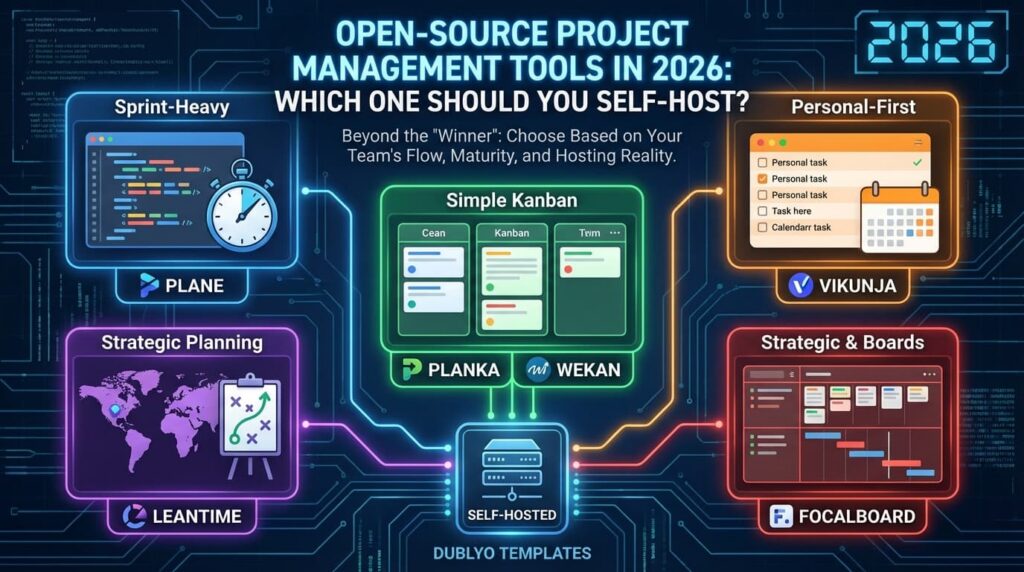
If you are searching for the best open-source project management software, the wrong approach is looking for one “winner.” These tools optimize for different team behaviors: sprint-heavy engineering, simple Kanban execution, personal-first task planning, or strategic planning workflows.
This guide compares six tools from your Dublyo templates: Plane, Leantime, Planka, Vikunja, Wekan, and Focalboard. It is written to help you choose based on team maturity, process complexity, and hosting reality.
Table of contents
- Quick picks by team type
- Comparison table
- Tool-by-tool analysis
- How to choose the right PM tool
- Migration planning checklist
- Deploying on Dublyo
- FAQ
- References
Quick picks by team type
- Best Jira/Linear-style replacement: Plane
- Best strategy + planning blend for non-PM-heavy teams: Leantime
- Best Trello-like modern Kanban UX: Planka
- Best lightweight personal/team task system: Vikunja
- Best permissive-license Kanban baseline: Wekan
- Best for existing users maintaining old boards: Focalboard
Comparison table
| Tool | Best for | License (template metadata) | Dublyo deploy signal |
|---|---|---|---|
| Planka | Clean Kanban collaboration | AGPL-3.0 | 139 deployments |
| Focalboard | Board-style teams with Notion/Trello habits | AGPL-3.0 | 132 deployments |
| Leantime | Teams needing strategy + execution in one place | AGPL-3.0 | 130 deployments |
| Plane | Engineering-heavy planning and delivery workflows | AGPL-3.0 | 103 deployments |
| Vikunja | Lightweight task and project management | AGPL-3.0 | 83 deployments |
| Wekan | MIT-licensed self-hosted Kanban | MIT | 62 deployments |
Deploy signal values come from your template metadata and show practical usage tendency in your current ecosystem.
Tool-by-tool analysis
1) Plane
Plane is the strongest “engineering workflow” option in this set. It maps well to teams that think in issues, sprints, roadmaps, and structured product delivery.[1][2]
- Strengths: modern PM workflow posture, strong engineering-team fit, broad project structure.
- Watch-outs: more moving parts than simple Kanban tools; small teams may find it heavy if they only need boards and checklists.
- Best fit: startups and product teams replacing Jira/Linear-style flows.
2) Leantime
Leantime is built for teams that need more than task tracking. It combines execution with strategy-oriented planning concepts, making it useful for founders and cross-functional teams.[3][4]
- Strengths: strategic planning support, non-enterprise-friendly complexity level, practical for small-to-mid teams.
- Watch-outs: if your team only wants simple Kanban, Leantime can feel broader than needed.
- Best fit: product/ops teams mixing strategic planning with day-to-day execution.
3) Planka
Planka is one of the best choices when your team wants a clear Trello-like experience with fast onboarding and low friction.[5][6]
- Strengths: intuitive board workflow, clean UI, easy team adoption.
- Watch-outs: Kanban-centric tools may require complementary tooling for advanced roadmap/reporting needs.
- Best fit: teams that care about simplicity, speed, and board-first collaboration.
4) Vikunja
Vikunja is a lightweight task manager with project capabilities. It is a strong option for users who prioritize performance, simplicity, and lower operational overhead.[7][8]
- Strengths: lean architecture, straightforward operation, good personal/team hybrid behavior.
- Watch-outs: advanced enterprise PM reporting needs may require extra tooling.
- Best fit: small teams, founder-led teams, and personal-to-team scaling workflows.
5) Wekan
Wekan remains a practical choice for organizations that specifically prefer MIT-licensed open-source software for compliance/procurement reasons.[9][10]
- Strengths: permissive MIT licensing, mature Kanban model, straightforward self-hosting options.
- Watch-outs: UX feels more utilitarian than newer PM tools.
- Best fit: license-sensitive teams needing reliable board-based execution.
6) Focalboard
Focalboard is still useful for existing users who already run it and want continuity. For net-new rollouts, evaluate current upstream/community activity and maintenance status before committing long-term.[11][12]
- Strengths: familiar board paradigm and broad user familiarity.
- Watch-outs: verify roadmap and release cadence for your risk tolerance.
- Best fit: continuity use cases rather than greenfield strategic PM platform selection.
How to choose the right PM tool
1) Start with your process maturity
If you already run structured sprints/roadmaps, Plane will likely fit better. If you need simple execution boards, Planka or Wekan usually fit faster.
2) Decide if strategy should live in the same system
If yes, Leantime is a strong candidate because it blends planning and execution patterns.
3) Validate license fit early
Some teams can adopt AGPL tools easily; others require permissive licensing for legal/procurement reasons. Resolve this early to avoid re-platforming later.
4) Model your “team growth” cost and complexity
Pick the tool you can still operate cleanly at 3x current team size. Migration later is always more expensive than expected.
5) Run a 14-day pilot with real projects
Do not evaluate with fake demo tasks. Use a real backlog, real assignees, and real sprint/release workflows before finalizing.
Migration planning checklist
- Map existing entities: projects, issues, labels, sprints, milestones, comments.
- Define archive and retention policy before importing legacy data.
- Test one pilot project first, then roll out to the full org.
- Create role permissions and workspace conventions in advance.
- Write a short team handbook for board hygiene and workflow states.
Deploying these on Dublyo
All six tools in this guide are available in your Dublyo templates, so you can deploy with less DevOps friction while keeping infrastructure choice across Hetzner, Vultr, DigitalOcean, and OneProvider.[13][14]
Deploy an open-source PM tool on Dublyo
FAQ
What is the best open-source project management tool in 2026?
There is no single best option. Plane is strong for structured engineering workflows, Planka/Wekan for board-first simplicity, and Leantime for strategy + execution blend.
Which tool is best if we currently use Trello-style boards?
Planka or Wekan are usually the fastest transitions for Trello-style teams.
Which option is best for startups replacing Jira?
Plane is usually the first tool to evaluate if you need modern issue/sprint/roadmap workflows with self-hosting control.
Does license type matter for company adoption?
Yes. Legal and procurement teams often require specific license types. Validate this before selecting your long-term PM platform.
Can we run these on one server?
Yes for many small-to-mid workloads, but capacity planning depends on team size, activity volume, and whether you co-host additional services.